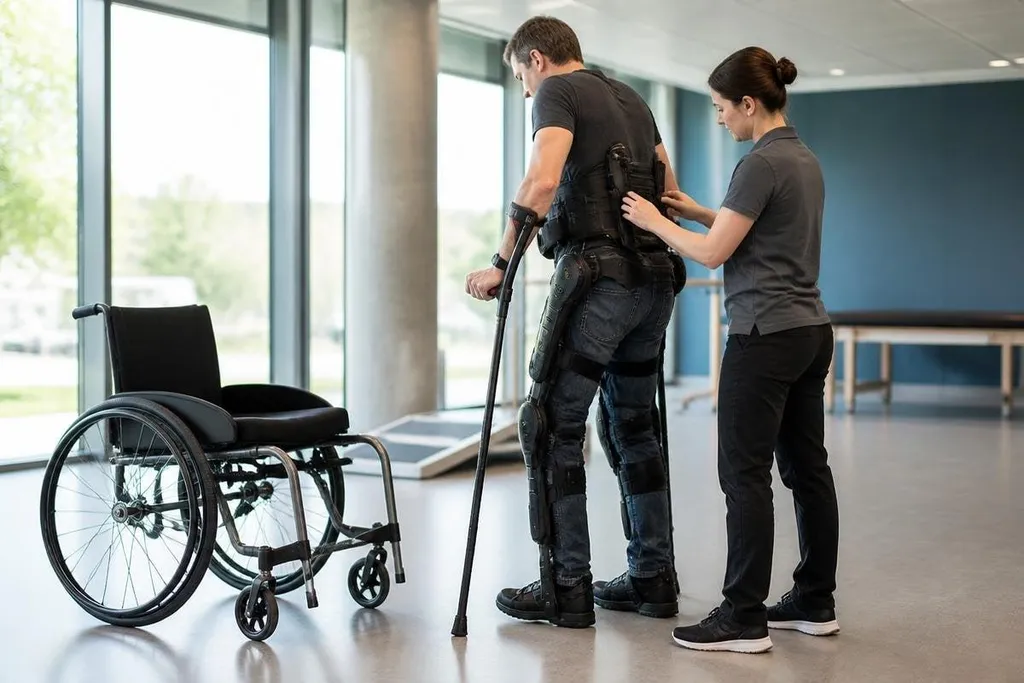
A powered exoskeleton can move a person’s legs while a frame supports their body. That can help some wheelchair users stand and walk for set tasks, but it doesn’t remove the need for a wheelchair in daily life.
- Exoskeletons need the wearer to fit the frame and control their balance.
- Wheelchairs remain better for speed, long distances, uneven ground, and rest.
- The right choice depends on strength, joint movement, medical advice, and where the device will be used.
What an exoskeleton changes
An exoskeleton uses motors, batteries, sensors, and leg braces to guide steps. The user may start a step with a button, shift of weight, or other control input, depending on the design. The frame then moves the hips and knees through a planned pattern.
That movement can put the user upright for a short walk or standing task. Standing may help with eye-level conversations, reaching shelves, or moving through places where a chair cannot fit. These uses matter, but they are different from replacing a chair for a full day.
A wheelchair carries the user while they work, travel, or rest.
An exoskeleton asks the user to wear a powered frame and keep enough control to stand safely. The two devices solve different problems.
Where wheelchairs still work better
A wheelchair offers a stable seat and quick movement with less physical demand on the user. It can also carry items, work on many surfaces, and remain ready without a long setup period. Those traits matter in a home, workplace, hospital, or public building.
The frame may need a flat surface, clear space, charged batteries, and another person nearby. The user may need help putting it on, adjusting the leg braces, and moving from a chair into the frame. A motor fault or low battery can end a walk sooner than planned.
Balance is another limit. Some systems support the knees and hips, but the user may still need to control their upper body. A person with limited trunk control, joint movement, or bone strength may not be a safe match for a particular model.
The medical and daily-use gap
A planned session with an exoskeleton can help, yet daily walking asks more of the device. Door thresholds, slopes, wet floors, crowds, tight rooms, and long waits all change the task. A lab or clinic can control many of those conditions; a home cannot.
The device also has to fit the person’s body. Small changes in leg length, brace position, muscle strength, or pain can affect how a step feels. Medical staff and trained specialists need to check those factors before regular use.
An exoskeleton’s first few steps don’t answer whether a person can manage a full day without a chair. A useful report names the device, people tested, walking distance, support needs, and follow-up period. Robot24.com can connect those details to claims about assistive robots before the next section looks at daily use.
The strongest case for an exoskeleton is often added standing or short walking practice, not a chair-free life. A person may use both devices in the same week, or on the same day, for different jobs.
A useful buying checklist
Before you compare models, check these points with a clinician, supplier, or rehabilitation team:
- Body fit: Confirm the supported height, weight, leg length, and joint range.
- Transfer method: Ask how the user moves from a wheelchair into the frame.
- Surface limits: Check rules for slopes, door thresholds, wet floors, and outdoor paths.
- Battery plan: Find the stated walking time and what happens when charge runs low.
- Human help: Decide who assists with fitting, charging, transport, and an emergency stop.
- Daily role: Write down the tasks the exoskeleton must handle, then compare them with the chair already in use.
The answer for most users
I'd reject the word “replace” for most wheelchair users. An exoskeleton may add standing and short walking to a mobility plan, while a wheelchair still handles the hours, distances, and surfaces that powered leg frames do not.
The useful question is which task needs solving first. Until exoskeletons can handle transfers, uneven ground, long waits, low batteries, and changing indoor spaces with little help, they remain a second mobility tool rather than a full substitute.